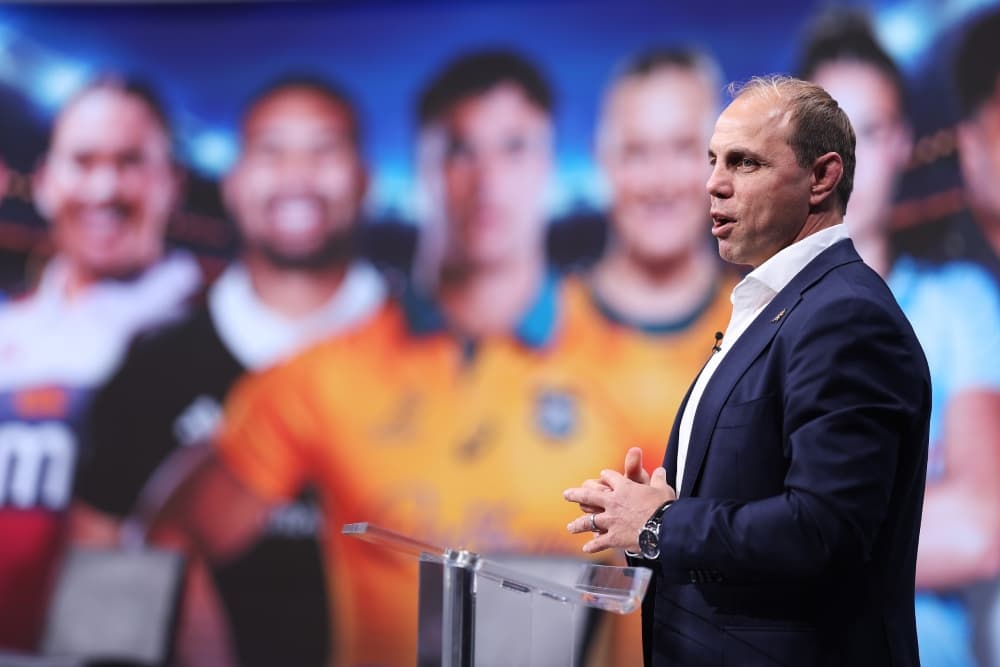
After a record surplus, Rugby Australia CEO Phil Waugh has stressed the importance of avoiding the same mistakes as 2003 as he looks to set the game up for the future.
The $70.6 million is the largest ever surplus announced by the organisation, almost double the next best amount.
Watch every second of the 2026 Super Rugby Pacific season live and on demand via Stan Sport.
It comes off the back of higher-than-projected sales for non-Lions tour matches and hospitality revenue, leaving the code with over $30 million in cash reserves.
The announcement is a stark contrast from five years ago, where then Chairman Hamish McLennan said the game had to consider the potential of amateurism amid COVID disruptions.
During that period, RA took out a debt facility instead of opting for private equity, a move which has literally paid itself off earlier than expected.
“It’s been a pivotal shift, really," Waugh said.
“I think that if you go back to the process we went through in terms of the private equity conversations and then in parallel taking out or exploring the debt facility…the decision that the board made along with the executive to go down the debt path and then the overperformance in 2025 to exit the debt facility on the 29th of August, which is at least 12 months before we projected to exit the debt facility, is really pleasing.
“So by no means are we out of the woods. I think that what we've been talking about for a long time is around a sustainable model, and we need to ensure that we're setting up that sustainable model until the end of our next broadcast cycle, and we're on the path of doing that.”
Rugby Australia has been in a similar position before, with revenue from the 2003 Rugby World Cup as the previous record.
However, a lack of clarity around direction led to disappointing returns, leaving Waugh and the organisation placing heavy emphasis on not only safeguarding but growing the code's future.
“We've been quite deliberate in talking about the investment fund and ensuring that we establish a similar concept to what funds or a third of the Olympic team's performance funding through the establishment of the Australian Olympic Foundation in 2000, and that's certainly a great example of what we'd like to get to post-2027," he believes.
“I think that not just in Australia, but I think globally national unions have got into the habit of spending money before they have it, and ultimately then big events pay down that money.
“It’s really deliberate for us will be quarantining the revenues from the Rugby World Cup to ensure that the game's set up in perpetuity."
Whilst Waugh concedes a small deficit is expected for 2026, he was confident the new Nations Championship will help boost the game's earning capacity,
“I think just the concept will be additive in terms of value, in terms of July and November no longer being friendlies, it'll be for a joint championship, so that will assist with resonating with fans," he said.
“As we have a broader joint venture with Six Nations and our SANZAAR partners on the competition itself, and as you then get broadcast coming through and you can sell the competition as a package, we're very optimistic around the revenue upside on the back of that.
Women's Rugby remains a key focus ahead of the 2029 Rugby World Cup, as Waugh projects significant investment on the road to further professionalism.
“We're in the top three to four countries in the world in terms of our women's 15s investment…We're in market for a technical director and we're well advanced as to what that structure looks like but certainly our intent to have a full-time Wallaroos program as we prepare through to 2029," Waugh added.
“We're really conscious that we've got a very successful women's sevens program that essentially led women's professional sport in Australia when they were established in 2014, a centralised program, and through to 2016 won the gold medal.
“We need to have that same aspiration with our Wallaroos in the fact that we bring them together, a centralised program, better cohesion, continuity, and then the performances increase from there and in addition to that, the teams that are doing the best in women's 15s around the world, the teams that are integrating their sevens players with their 15s players and getting the best athletes for critical events
“We don't shy away from the fact that we've got a world-leading sevens program in the women's space but what we haven't done is integrated into the women's 15s space like others have and that's certainly something we're exploring at the moment."